
Computational Oncology
Predict where a drug will work, from its structure alone.
Enter a molecule. Get a ranked map of cancer indications where it shows response signal, in seconds, drawn from cell-line pharmacogenomics. Designed by professors at the Karolinska Institutet and KTH Royal Institute of Technology.
Hypothesis-grade triage signal. Not a clinical prediction.
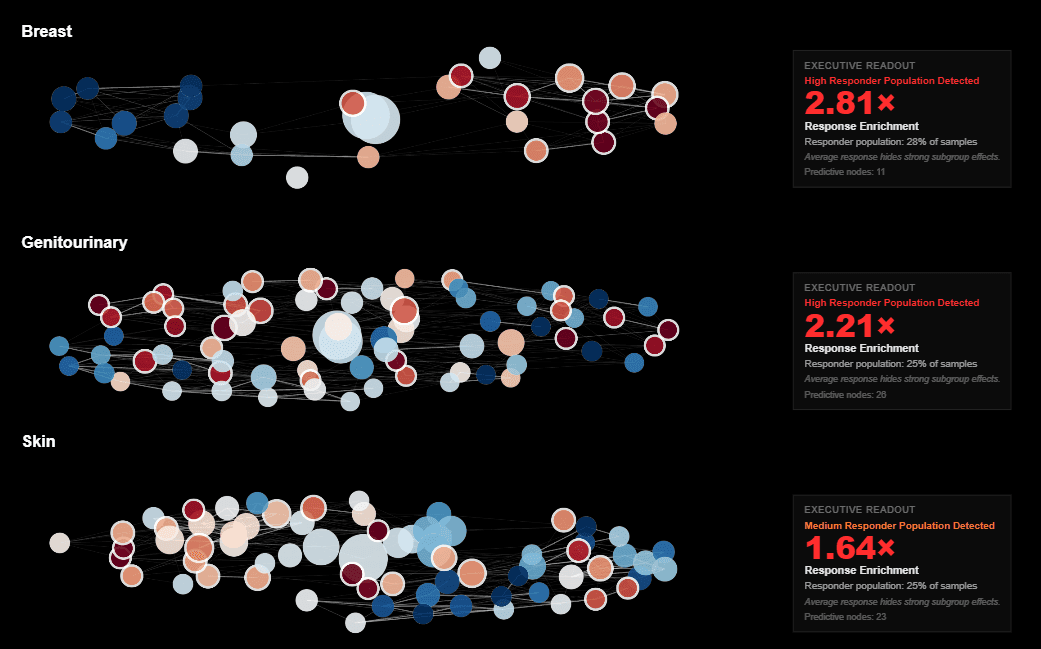
Responder-map excerpt · geometric method, from our preprint
One method, two homes
A geometric engine, on public and private data.
The same underlying method runs on public pharmacogenomic data (as The Responder Atlas) and on a client's private patient data (as Trial Enrichment Strategy). The two run on different data and are never mixed.
Platform
The Responder Atlas.
Our platform built on public pharmacogenomic data. Query it by molecule for indication signal, responder structure, and candidate biomarkers. Starts with DepMap; expands to more public sources over time.
Applications
Available now
Imputation
Structure to indication signal in seconds. A ranked map across 17 cancer tissue types with a confidence tier. Free to try, with full responder reports available.
Open the toolComing soon · in development
Biomarker SaaS
Search the Atlas by biomarker or gene signature to find compounds with matching responder structure. Not built yet. Early access can be requested.
Separate · patient data
Trial Enrichment Strategy.
The same geometric method, applied privately to your trial's patient data, separate from the public Atlas platform. In JAVELIN Renal 101 it predicted responders with 82.0% out-of-sample accuracy, with the predicted-responder subgroup carrying 79.2% of the treatment effect.
On your cohort
Engagement
Find the responders in your trial.
Bring your cohort's tumor gene-expression data; we return an out-of-sample responder classification, method audit, and deployable pipeline. See the method and the JAVELIN Renal 101 reference result.
See the method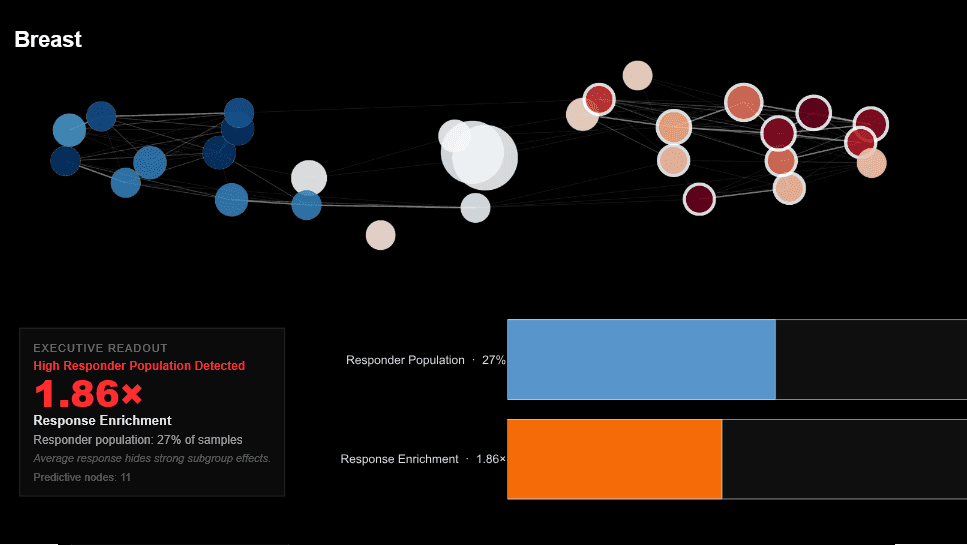
Example · irinotecan responder map
Application of Responder Atlas
Structure to indication signal, instantly.
Paste a SMILES string. Imputation queries Responder Atlas , our platform built on public pharmacogenomic data. It returns a ranked signal across 17 cancer tissue types with a confidence tier from chemical similarity to the training set. No account needed.
17 indications, ranked
Every query returns the full tissue-level signal, ordered.
Confidence you can read
Each result carries an elevated / moderate / exploratory tier based on chemical similarity.
Grounded in real data
Predictions derive from DepMap/PRISM cell-line response, not a black box.
Flagship · Trial Enrichment Strategy
Our flagship: geometric trial enrichment.
82.0%
Out-of-sample accuracy predicting treatment responders in the JAVELIN Renal 101 trial.
79.2%
Share of the total treatment effect concentrated in the predicted-responder group.
In JAVELIN Renal 101 (avelumab plus axitinib, advanced renal cell carcinoma, open-source Pfizer data), our unsupervised geometric method separated responders from non-responders with no target information supplied. From our preprint.
Trial Enrichment Strategy uses the same geometric method as Responder Atlas, run privately on your cohort's data rather than on public data.
See the full method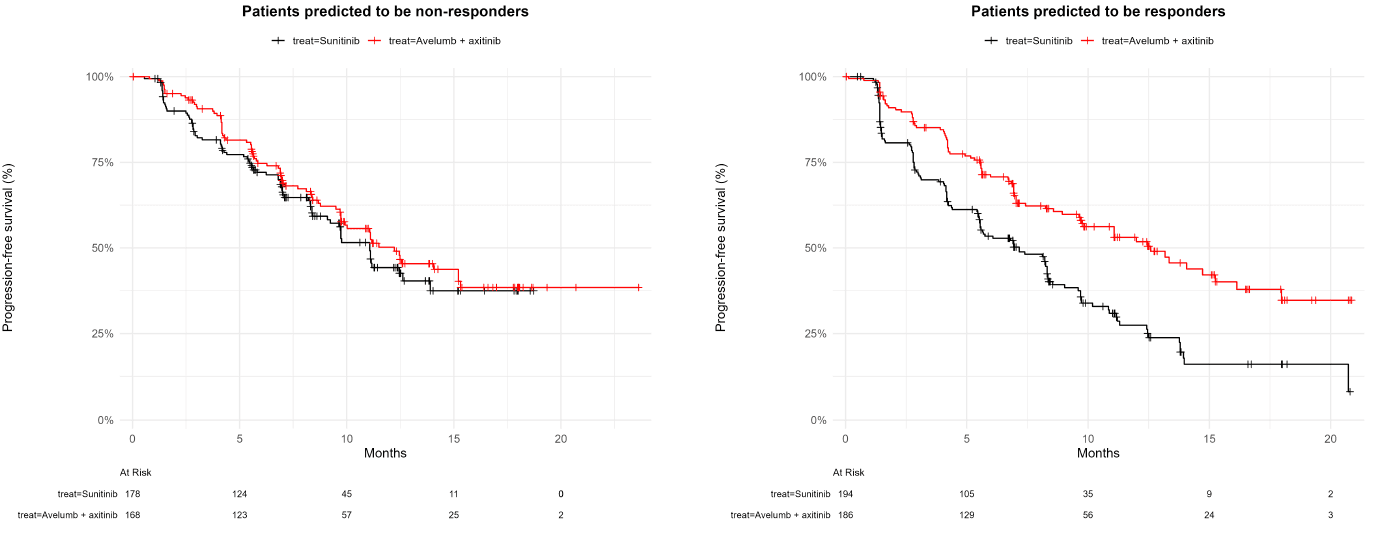
Rigor
A method that recovers what's already known.
A response model is only trustworthy if it rediscovers established biology. Tested on four targeted oncology drugs, our unsupervised responder signal ranked each drug's canonical driver first out of hundreds of candidate genes, with no target information supplied. Vemurafenib recovered BRAF. Alpelisib recovered PIK3CA. Selumetinib recovered KRAS. This is a categorical recovery on clean-driver cases, unpublished and part of a manuscript in preparation.
- 01
Vemurafenib recovered BRAF.
Rank 1 of hundreds
- 02
Alpelisib recovered PIK3CA.
Rank 1 of hundreds
- 03
Selumetinib recovered KRAS.
Rank 1 of hundreds
Developed by professors at the Karolinska Institutet and KTH Royal Institute of Technology.
Expectations & limits
What imputation prediction can and can't tell you.
What it is
A fast, structure-based triage signal for indication prioritization, grounded in public pharmacogenomic data and validated against known biology.
What it isn't
A clinical or efficacy prediction. A substitute for experimental validation. Cross-tissue selectivity, the hardest axis, sits at the structural limit of chemistry-only methods, and we say so.
Responder Lab

From the team behind The Responder Lab.
Responder.bio is our open product suite. The Responder Lab is our clinical-trial intelligence practice.